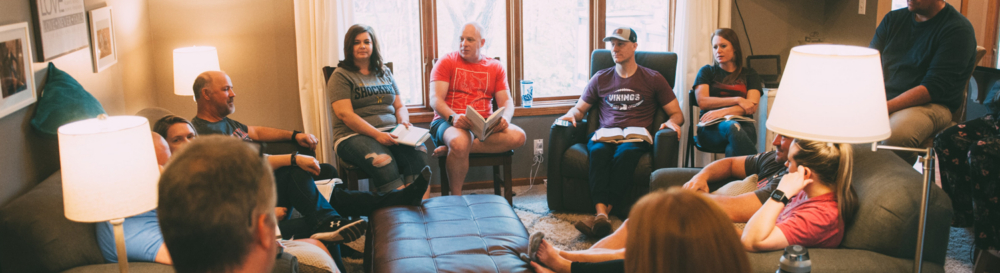
Our Catholic faith was never meant to be lived alone.
We gather as one Church around the Eucharist each Sunday, but smaller communities give us a place to become known, to speak about faith, to listen to one another, to pray together and to walk with each other through everyday life. A person can be part of a parish for years and still wonder, Does anyone really know me? Would anyone notice if I wasn’t here?
Small groups help change that. They create a smaller place within the parish where people can move from attending to belonging, from talking about faith to sharing faith, and from simply sitting beside one another to walking with one another.
To help make that easier, the Diocese of Wollongong provides three small-group resources built around the upcoming Sunday Gospel. Each has a different audience and style, so you can choose the resource that best suits your group.
“For where two or three meet in my name, I shall be there with them.” MATTHEW 18:20
Which resource should we use?
There isn’t a “better” resource. Choose the one that will best help the people actually sitting in your group.
Choose Faith Circles if your group enjoys going deeper into Scripture and papal teaching and wants substantial material for reflection and discussion.
Choose LIFE Groups if your priority is creating a warm, accessible environment where a broad range of people can connect Sunday’s Gospel with their own lives and build meaningful community.
Choose YLIFE if you’re gathering young people from Year 10 through to young adulthood and need language, examples and questions that meet them where they are. YLIFE will be available from 2027.
And don’t be afraid to change. A group may begin with one resource and discover that another suits them better.
The resource serves the group. The group doesn’t exist to get through the resource.
Three resources for sharing faith
Faith Circles
Faith Circles is our original small-group resource for Catholics who enjoy exploring Scripture and Church teaching in greater depth. Each week pairs the upcoming Sunday Gospel with a papal homily or reflection, giving groups substantial material for discussion. Head, Heart and Hands questions help participants consider its meaning, reflect on their own lives and respond in faith, with time to pray together.
LIFE Groups help Catholics build community through sharing faith and everyday life. Each week pairs the upcoming Sunday Gospel with an accessible reflection inspired by a papal message. Head, Heart and Hands questions encourage personal conversation and practical responses to the Gospel, with time to pray for one another. Suitable for a broad range of parishioners, including new or returning Catholics and groups continuing after Alpha.
YLIFE helps young people from Year 10 through to young adulthood explore the Sunday Gospel through language, stories and questions that connect with their lives. Each week includes an accessible reflection inspired by a papal message and Head, Heart and Hands questions about faith and everyday experiences. No prior theological knowledge is assumed, making room for those confident in their faith and those still exploring.
A LIFE Group is usually a small group of around 6–10 people who gather regularly to grow in relationship, faith, discipleship and prayer.
It isn’t primarily a class or a Bible study. The aim is to do life together as disciples of Jesus.
A gathering can be very simple:
CONNECT
Have a cuppa, share some food, catch up and make space for people to know one another.
LISTEN
Read the Sunday Gospel and use one of the resources above as a simple input.
SHARE
Use the Head, Heart and Hands questions to talk about faith and life. You don’t need to answer every question.
PRAY
Make time to pray together and, where appropriate, pray for the things people have shared.
Weekly or fortnightly usually gives relationships the opportunity to grow, but the rhythm should be realistic for your group.
Why small groups?
Sunday Mass brings the whole parish together in worship. Small groups give people another kind of space within that larger community.
A smaller circle makes it possible for people to say:
I am known here.
I am missed here.
I can talk about faith here.
I can be prayed for here.
I am growing here.
I have a place here.
This is why small-group community is an important part of parish renewal.
We aren’t trying to create more meetings.
We’re trying to create communities where people are known, loved, supported, formed and sent.
FAQs
Do I need to be an expert to lead a group?
expand_more
No.
A good host doesn’t need to have all the answers. In fact, the group will usually be healthier if the host doesn’t try to provide them.
Your role is to welcome people, help everyone participate, keep the conversation moving, protect the safety of the group and make space for prayer.
The resources do much of the preparation for you.
Do we have to get through the whole resource?
expand_more
Absolutely not.
The purpose isn’t to finish the page.
If one question leads to a meaningful conversation that helps people share honestly, listen to one another and pray together, stay there.
The conversation is more important than completion.
How often should a group meet?
expand_more
Weekly or fortnightly works well for many LIFE Groups because trust and friendship grow through consistency.
Some groups may meet monthly.
It can also be helpful to begin with a defined season, such as six weeks or a school term, and then decide together whether to continue.
Where can we meet?
expand_more
Almost anywhere that allows comfortable conversation:
someone’s home
a parish meeting room
a café
outdoors
online
The space matters less than creating an environment where people feel welcomed, safe and able to participate.
What are Head, Heart and Hands?
expand_more
Every resource uses three kinds of questions.
HEAD: What do I think? These questions help us understand the Gospel and consider what it is saying.
HEART: What do I feel? These questions help us connect faith with our experiences, relationships and interior life.
HANDS: What can I do? These questions help us consider how we might respond concretely to what God is showing us.
Together, they help faith move from something we simply discuss to something we recognise and live.
What makes a healthy small group?
expand_more
A few simple principles make an enormous difference.
What is shared personally should be treated with confidentiality and respect.
Listen without immediately interrupting, correcting, advising or trying to fix someone.
Don’t pressure anyone to share more deeply than they’re comfortable sharing.
Give relationships time to grow. Trust cannot be rushed.
And above all, remember that the purpose of the group isn’t impressive discussion. It is helping one another grow closer to Jesus and to one another.
Can we invite someone who isn't Catholic?
expand_more
Yes.
LIFE Groups and YLIFE are particularly accessible for people exploring Christianity, those who have completed Alpha, new or returning Catholics, and people who may still have plenty of questions.
Create an environment in which questions are welcome and nobody feels expected to pretend they know or believe more than they do.
Faith Circles may be more suitable once someone is comfortable engaging more deeply with Catholic teaching and papal reflections.
How do I find or start a group?
expand_more
If you’d like to join an existing group, contact your local parish.
If there isn’t a group available, consider gathering a few people yourself. Start small. Invite people personally. Choose the resource that best suits them, agree on a simple rhythm, and begin.
The Office of Renewal and Evangelisation can also help parishes and individuals establish healthy small-group community.
Account means the account held at your financial institution from which we are authorised to arrange for funds to be debited.
Agreement means this Direct Debit Request Service Agreement between you and us, including the direct debit request.
Business day means a day other than a Saturday or a Sunday or a listed public holiday.
Debit day means the day that payment is due.
Debit payment means a particular transaction where a debit is made, according to your direct debit request.
Direct debit request means the Direct Debit Request between us and you.
Us and we and our means the Catholic Development Fund.
You means the customer(s) who signed the direct debit request. Your financial institution is the financial institution where you hold the account that you have authorised us to arrange to debit.
Debiting your account
By submitting a direct debit request, you have authorised us to arrange for funds to be debited from your account according to the agreement we have with you.
We will only arrange for funds to be debited from your account:
As authorised in the direct debit request; if the debit day falls on a day that is not a business day, we may direct your financial institution to debit your account on the following or previous business day. If you are unsure about which day your account has or will be debited, please check with your financial
Changes by you
If you wish to stop or defer a debit payment you must write to us at least 5 business days before the next debit day.
This notice should be given to us in the first instance.
Your obligations
It is your responsibility to ensure that there are sufficient clear funds available in your account to allow a debit payment to be made.
If there are insufficient clear funds available in your account to meet a debit payment:
you or your account may be charged a fee and/or interest by your financial institution;
you or your account may be charged a fee to reimburse us for charges we have incurred for the failed transaction;
you must arrange for the payment to be made by another method
Please check your account statement to verify that the amounts debited from your account are correct.
Dispute
If you believe that there has been an error in debiting your account you should call us on (02) 4222 2444 and confirm the details in writing with us as soon as possible so that we can resolve your query quickly.
Accounts
You should check:
with your financial institution whether direct debiting is available from your accounts offered by financial
your account details which you have provided to us are correct by checking them against a recent account statement; and
with your financial institution before completing the direct debit request if you have any queries about how to complete the direct debit
Warning: if the account number you have quoted is incorrect, you may be charged a fee to reimburse our costs in correcting any deductions from:
an account you do not have authority to operate; or
an account you do not
Confidentiality
We will keep any information (including your account details) in your direct debit request confidential.
We will make reasonable efforts to keep any such information that we have about you secure and to ensure that any of our employees or agents who have access to information about you, do not make any unauthorised use, modification, reproduction or disclosure of that information.
However, we may use your contact details to provide information about the fund. Should you wish this not to be the case, please advise the fund in writing.
Disclosure statement
The Catholic Development Fund, Diocese of Wollongong (the Fund) is required by law to make the following disclosure: The Fund is not prudentially supervised by the Australian Prudential Regulation Authority nor has it been examined or approved by the Australian Securities and Investments Commission. An investor in the Fund will not receive the benefit of the financial claims scheme or the depositor protection provisions in the Banking Act 1959 (Cth). Investments in the Fund are intended to be a means for investors to support the charitable, religious and education works of the Diocese of Wollongong and for whom the consideration of profit are not of primary relevance in the investment decision. The investments that the Fund offers are not subject to the usual protections for investors under the Corporations Act (Cth) or regulation by Australian Securities and Investments Commission. Investors may be unable to get some or all of their money back when the investor expects or at all and any investment of the Fund are not comparable to investments with banks, finance companies or fund managers. The Fund’s identification statement may be viewed at www.cdfwollongong.org.au or by contacting the Fund. The Fund does not hold an Australian Financial Services Licence.
Our diocesan logo is theologically rich and very succinct. As a hand, it depicts our mission as a diocese and as individuals within the diocese, of bearing (bringing, carrying) Christ’s love to one another and to the world around us. In this, we are the hand of Jesus Christ, and we are offering ourselves to him so that he might work through us.
We can be the bearers of his love only as a response to his call and in the strength of his grace. We are reminded of this in two ways—through the symbol of the dove (the Holy Spirit) also present in the logo, and by the incorporation of the cross that segments the logo. The presence of the cross is a reminder that bearing the love of Christ will inevitably cost us if we live it authentically. However, in the way that the Cross is the portent of redemption and life—an echo of the tree of life in the book of Genesis—so becoming bearers of the love of Christ will also bring us to life.
The four fingers of the hand also represent the four regions of our diocese. The first is bluerepresenting the beautiful water of the Shoalhaven. The second is a blue and green combination representing the waters and escarpment of the Illawarra. The third is greendepicting the hills and plains of the Macarthur. The fourth is dark green illustrating the forests of the Southern Highlands.