St Carlo Acutis major pilgrim relic mission in the diocese!
From 14 to 21 September 2026, the Diocese of Wollongong will welcome the Major Pilgrim Relic of St Carlo Acutis as part of its Australian Mission.
Across Oran Park, Rosemeadow, Nowra, Vincentia and Wollongong, the faithful will have opportunities to attend Mass, spend time in Eucharistic Adoration, venerate the relic, receive the Sacrament of Reconciliation and learn more about the life and witness of this remarkable young saint.
The relic visiting the diocese is a piece of St Carlo Acutis’ heart pericardium, the membrane surrounding the heart. The Mission has been entrusted to Friends of St Carlo Acutis Australia.
Everyone is welcome to take part in the public celebrations, spend time in prayer before the relic and discover more about the life of a young saint who made friendship with Jesus the centre of everything. See below for the full itinerary.
For more infomation, please contact Dr Edsel Park (Coordinator of Liturgy) at [email protected] or (02) 4222 2427
FAQs
Who is St Carlo Acutis?
expand_more
St Carlo Acutis was an ordinary teenager whose short life was marked by an extraordinary love for Jesus, especially in the Eucharist.
Born in London in 1991 and raised in Milan, Carlo enjoyed many of the things familiar to young people today, including computers, video games, sport and time with friends. Alongside these interests was a deep spiritual life. He attended Mass frequently, prayed the Rosary and had a particular devotion to the Eucharist. He also used his skills with computers and web design in the service of the Church, including creating an online exhibition documenting Eucharistic miracles around the world.
Carlo was also known for his concern for people who were poor or excluded. His faith was not separate from everyday life, but shaped the way he treated the people around him.
In 2006, Carlo was diagnosed with an aggressive form of leukaemia. He died on 12 October that year at only 15 years of age. He was beatified in Assisi in 2020 and canonised by Pope Leo XIV on 7 September 2025, becoming the first saint of the millennial generation.
His life continues to speak particularly strongly to young people because his holiness was lived in circumstances that feel recognisably modern. Carlo showed that sanctity does not require withdrawing from ordinary life, but allowing friendship with Christ to transform it.
“The Eucharist is my highway to heaven.”
What is a relic?
expand_more
Relics have been part of Christian devotion since the earliest centuries of the Church.
A relic is the physical remains of a saint, an object that belonged to a saint, or something that has been brought into contact with the saint’s remains. The Church preserves and honours relics because the saints were real people whose bodies were temples of the Holy Spirit and through whom God worked during their earthly lives.
Catholics do not worship relics. Worship belongs to God alone. Rather, relics are venerated, meaning they are treated with reverence because of the person whose life they represent.
Just as we might treasure a photograph or an object belonging to someone we love, a relic gives us a tangible connection with a member of the Church who has gone before us. More importantly, it points beyond itself to Christ and invites us to imitate the saint’s faithfulness.
The Church has careful procedures for authenticating, preserving and displaying relics. Canon law also strictly prohibits their sale.
What does it mean to venerate the relic?
expand_more
Veneration is an act of prayerful respect.
When approaching St Carlo’s relic, you might make the Sign of the Cross, pause in prayer, ask for his intercession, or simply spend a few moments asking God to deepen your own friendship with Christ.
There is no required formula and nothing magical about the relic itself. The focus is always God. The saint accompanies us through prayer as another member of the Communion of Saints.
For Carlo in particular, this naturally points us towards the Eucharist, which stood at the centre of his life.
Why is the Eucharist so important in St Carlo’s story?
expand_more
Carlo understood the Eucharist as the heart of his relationship with Jesus.
From a young age he attended Mass regularly and spent time before the Blessed Sacrament. His well-known description of the Eucharist as his “highway to heaven” captures the simplicity of his spirituality. Holiness, for Carlo, began by remaining close to Christ.
His interest in Eucharistic miracles grew from this devotion. Using his computer skills, he researched and catalogued recognised Eucharistic miracles from different parts of the world, creating an exhibition that has since been viewed internationally.
For this reason, the St Carlo Acutis Major Pilgrim Relic Mission is much more than an opportunity to see a relic. Its program of Mass, Eucharistic Adoration, prayer and Reconciliation reflects the very things that shaped Carlo’s own Christian life.
A saint for our time
expand_more
Part of Carlo’s appeal is that his life feels remarkably close to ours.
He lived with computers, the internet, school pressures, friendships and all the ordinary distractions of modern life. He did not reject these things. Instead, he tried to use them well and to keep Christ at the centre.
Pope Leo XIV, at Carlo’s canonisation in 2025, presented him alongside St Pier Giorgio Frassati as a young person who was deeply in love with Jesus and willing to give his life to him.
Carlo’s witness offers a simple challenge: holiness is possible here and now, in the circumstances of our own lives.
St Carlo’s 5 Steps to Holiness
expand_more
St Carlo’s desire for a living relationship with Jesus was evident from a very young age. At age seven, on the day of his First Holy Communion, he told his parents: “Always to be united to Jesus. This is my programme of life.” St Carlo’s ‘spiritual pericardium’ protected his relationship with Jesus, and consisted of five practices or appointments:
Frequent reception of the Eucharistic Jesus,
Adoration,
Spiritual direction and confession,
Devotion to the Blessed Mother and the saints, and
Acts of charity.
These practices led him to holiness and can likewise lead us to holiness, that we too may become saints.
Itinerary
Monday 14 September — Oran Park
Exhibition open: 12:00pm–7:00pm Veneration of the relic: 3:00pm–6:30pm and 8:00pm–9:00pm
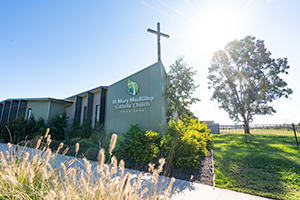
St Mary MacKillop Catholic Church (94 Oran Park Drive,
Oran Park)
Public access unavailable during school visits: 10.30am–12.00pm
2:00pm
Reception of the relic at the church
3:00pm–6:30pm
Exposition of the Blessed Sacrament and veneration of the relic
3:30pm–4:30pm
School program, open to public school students
6:15pm
Vespers
6:30pm
Benediction
7:00pm
Mass with talk
8:00pm
Refreshments
9:00pm
Departure of the relic
Tuesday 15 September — Rosemeadow
Exhibition open: 2:00pm–8:00pm Veneration of the relic: 3:00pm–6:30pm and 7:00pm–8:00pm
Our Lady Help of Christians Catholic Church (80 Demetrius Road,
Rosemeadow)
Public access unavailable during school visits: 9.15am–2.00pm
9:00am
Reception of the relic at the church
2:00pm–9:00pm
Public program commences with a talk
3:00pm–6:30pm
Exposition of the Blessed Sacrament and veneration of the relic
6:30pm
Mass with talk
7:00pm–8:00pm
Exposition and veneration continue
8:00pm
Departure of the relic
Wednesday 16 September — Nowra
Exhibition open: 11:00am–4:30pm Veneration of the relic: At different locations and times, as listed below
St Michael’s Catholic Church (30 North Street,
Nowra)
11:00am
Mass with reception of the relic at the church
12:30pm–4:30pm
Exposition of the Blessed Sacrament and veneration of the relic in the parish hall (accessible from the Polding Room)
5:30pm at Holy Spirit Catholic Church (23 St George Avenue,
Vincentia)
Mass with the relic
6:00pm
Talk and veneration of the relic
7:30pm at St Michael’s Catholic Church (30 North Street,
Nowra)
Talk and blessings with the relic
8:30pm
All-night exposition with veneration of the relic
Thursday 17 September — Nowra
Exhibition open: from 12:30pm
St Michael’s Catholic Church (30 North Street,
Nowra)
7:30am
Mass
1:00pm–5:30pm
Exposition of the Blessed Sacrament and veneration of the relic
5:30pm
Mass
6:00pm
Talk and Blessings with the relic
7:00pm
All-night exposition and veneration of the relic
Friday 18 September — Nowra
No exhibition or public veneration of the relic. The relic will depart for Wollongong early in the morning.
St Michael’s Catholic Church (30 North Street,
Nowra)
7:00am
Mass, followed by departure of the relic
7:30am
Departure the relic
Friday 18 September — Wollongong
Exhibition open: 10:00am–5:00pm Veneration of the relic: 11:00am–12:00pm and 3:00pm–5:00pm
St Francis Xavier Cathedral (36 Harbour Street,
Wollongong)
Public access unavailable during school visits:
Friday 10.15am–11.00am / Monday 9.30am–11.00am
11:00am–12:00pm
Exposition of the Blessed Sacrament and Confessions
12:10pm–1:00pm
Pilgrimage Mass and Reception of the relic
3:00pm–5:00pm
Veneration of the relic
Friday 18 September — Unanderra
Veneration of the relic: 6.30pm–8:30pm
(Please note, the Eucharistic Miracles exhibition will not be available at Unanderra)
Account means the account held at your financial institution from which we are authorised to arrange for funds to be debited.
Agreement means this Direct Debit Request Service Agreement between you and us, including the direct debit request.
Business day means a day other than a Saturday or a Sunday or a listed public holiday.
Debit day means the day that payment is due.
Debit payment means a particular transaction where a debit is made, according to your direct debit request.
Direct debit request means the Direct Debit Request between us and you.
Us and we and our means the Catholic Development Fund.
You means the customer(s) who signed the direct debit request. Your financial institution is the financial institution where you hold the account that you have authorised us to arrange to debit.
Debiting your account
By submitting a direct debit request, you have authorised us to arrange for funds to be debited from your account according to the agreement we have with you.
We will only arrange for funds to be debited from your account:
As authorised in the direct debit request; if the debit day falls on a day that is not a business day, we may direct your financial institution to debit your account on the following or previous business day. If you are unsure about which day your account has or will be debited, please check with your financial
Changes by you
If you wish to stop or defer a debit payment you must write to us at least 5 business days before the next debit day.
This notice should be given to us in the first instance.
Your obligations
It is your responsibility to ensure that there are sufficient clear funds available in your account to allow a debit payment to be made.
If there are insufficient clear funds available in your account to meet a debit payment:
you or your account may be charged a fee and/or interest by your financial institution;
you or your account may be charged a fee to reimburse us for charges we have incurred for the failed transaction;
you must arrange for the payment to be made by another method
Please check your account statement to verify that the amounts debited from your account are correct.
Dispute
If you believe that there has been an error in debiting your account you should call us on (02) 4222 2444 and confirm the details in writing with us as soon as possible so that we can resolve your query quickly.
Accounts
You should check:
with your financial institution whether direct debiting is available from your accounts offered by financial
your account details which you have provided to us are correct by checking them against a recent account statement; and
with your financial institution before completing the direct debit request if you have any queries about how to complete the direct debit
Warning: if the account number you have quoted is incorrect, you may be charged a fee to reimburse our costs in correcting any deductions from:
an account you do not have authority to operate; or
an account you do not
Confidentiality
We will keep any information (including your account details) in your direct debit request confidential.
We will make reasonable efforts to keep any such information that we have about you secure and to ensure that any of our employees or agents who have access to information about you, do not make any unauthorised use, modification, reproduction or disclosure of that information.
However, we may use your contact details to provide information about the fund. Should you wish this not to be the case, please advise the fund in writing.
Disclosure statement
The Catholic Development Fund, Diocese of Wollongong (the Fund) is required by law to make the following disclosure: The Fund is not prudentially supervised by the Australian Prudential Regulation Authority nor has it been examined or approved by the Australian Securities and Investments Commission. An investor in the Fund will not receive the benefit of the financial claims scheme or the depositor protection provisions in the Banking Act 1959 (Cth). Investments in the Fund are intended to be a means for investors to support the charitable, religious and education works of the Diocese of Wollongong and for whom the consideration of profit are not of primary relevance in the investment decision. The investments that the Fund offers are not subject to the usual protections for investors under the Corporations Act (Cth) or regulation by Australian Securities and Investments Commission. Investors may be unable to get some or all of their money back when the investor expects or at all and any investment of the Fund are not comparable to investments with banks, finance companies or fund managers. The Fund’s identification statement may be viewed at www.cdfwollongong.org.au or by contacting the Fund. The Fund does not hold an Australian Financial Services Licence.
Our diocesan logo is theologically rich and very succinct. As a hand, it depicts our mission as a diocese and as individuals within the diocese, of bearing (bringing, carrying) Christ’s love to one another and to the world around us. In this, we are the hand of Jesus Christ, and we are offering ourselves to him so that he might work through us.
We can be the bearers of his love only as a response to his call and in the strength of his grace. We are reminded of this in two ways—through the symbol of the dove (the Holy Spirit) also present in the logo, and by the incorporation of the cross that segments the logo. The presence of the cross is a reminder that bearing the love of Christ will inevitably cost us if we live it authentically. However, in the way that the Cross is the portent of redemption and life—an echo of the tree of life in the book of Genesis—so becoming bearers of the love of Christ will also bring us to life.
The four fingers of the hand also represent the four regions of our diocese. The first is bluerepresenting the beautiful water of the Shoalhaven. The second is a blue and green combination representing the waters and escarpment of the Illawarra. The third is greendepicting the hills and plains of the Macarthur. The fourth is dark green illustrating the forests of the Southern Highlands.